Sunday, September 4, 2016

48 The Roman Republic

http://www.ushistory.org/civ/6a.asp

 The Roman Republic

he Romans established a form of government — a republic — that was copied by countries for centuries In fact, the government of the United States is based partly on Rome's model.

It all began when the Romans overthrew their Etruscan conquerors in 509 B.C.E. Centered north of Rome, the Etruscans had ruled over the Romans for hundreds of years.
Once free, the Romans established a republic, a government in which citizens elected representatives to rule on their behalf. A republic is quite different from a democracy, in which every citizen is expected to play an active role in governing the state.


The Roman concept of the citizen evolved during the Roman Republic and changed significantly during the later Roman Empire. After the Romans freed themselves from the Etruscans, they established a republic, and all males over 15 who were descended from the original tribes of Rome became citizens. Citizens of Rome distinguished themselves from slaves and other noncitizens by wearing a toga; most wore a white toga. During the Empire, each emperor wore a purple toga to distinguish himself as the princeps, or "first citizen."
Citizenship varied greatly. The full citizen could vote, marry freeborn persons, and practice commerce. Some citizens were not allowed to vote or hold public office, but maintained the other rights. A third type of citizen could vote and practive commerce, but could not hold office or marry freeborn women.
In the late Republic, male slaves who were granted their freedom could become full citizens. Around 90 B.C.E., non-Roman allies of the Republic gained the rights of citizenship, and by 212 C.E, under the Edict of Caracalla, all free people of the Roman Empire could become citizens.

The aristocracy (wealthy class) dominated the early Roman Republic. In Roman society, the aristocrats were known as patricians. The highest positions in the government were held by two consuls, or leaders, who ruled the Roman Republic. A senate composed of patricians elected these consuls. At this time, lower-class citizens, or plebeians, had virtually no say in the government. Both men and women were citizens in the Roman Republic, but only men could vote.
Tradition dictated that patricians and plebeians should be strictly separated; marriage between the two classes was even prohibited. Over time, the plebeians elected their own representatives, called tribunes, who gained the power to veto measures passed by the senate.
Gradually, the plebeians obtained even more power and eventually could hold the position of consul. Despite these changes, though, the patricians were still able to use their wealth to buy control and influence over elected leaders.

Elephants marching from southern France

The Roman Senate
The history of the Roman Senate goes as far back as the history of Rome itself. It was first created as a 100-member advisory group for the Roman kings. Later kings expanded the group to 300 members. When the kings were expelled from Rome and the Republic was formed, the Senate became the most powerful governing body. Instead of advising the head of state, it elected the chief executives, called consuls.
Senators were, for centuries, strictly from the patrician class. They practiced the skills of rhetoric and oratory to persuade other members of the ruling body. The Senate convened and passed laws in the curia, a large building on the grounds of the Roman Forum. Much later, Julius Caesar built a larger curia for an expanded Senate.
By the 3rd century B.C.E., Rome had conquered vast territories, and the powerful senators sent armies, negotiated terms of treaties, and had total control over the financial matters of the Republic.
Senatorial control was eventually challenged by Dictator Sulla around 82 B.C.E. Sulla had hundreds of senators murdered, increased the Senate's membership to 600, and installed many nonpatricians as senators. Julius Caesar raised the number to 900 (it was reduced after his assassination). After the creation of the Roman Empire in 27 B.C.E., the Senate became weakened under strong emperors who often forcefully coerced this ruling body. Although it survived until the fall of Rome, the Roman Senate had become merely a ceremonial body of wealthy, intelligent men with no power to rule.


Occasionally, an emergency situation (such as a war) arose that required the decisive leadership of one individual. Under these circumstances, the Senate and the consuls could appoint a temporary dictator to rule for a limited time until the crisis was resolved. The position of dictator was very undemocratic in nature. Indeed, a dictator had all the power, made decisions without any approval, and had full control over the military.
The best example of an ideal dictator was a Roman citizen named Cincinnatus. During a severe military emergency, the Roman Senate called Cincinnatus from his farm to serve as dictator and to lead the Roman army. When Cincinnatus stepped down from the dictatorship and returned to his farm only 15 days after he successfully defeated Rome's enemies, the republican leaders resumed control over Rome.

The Twelve Tables

One of the innovations of the Roman Republic was the notion of equality under the law. In 449 B.C.E., government leaders carved some of Rome's most important laws into 12 great tablets. The Twelve Tables, as they came to be known, were the first Roman laws put in writing. Although the laws were rather harsh by today's standards, they did guarantee every citizen equal treatment under the law.

47 Founding of Rome

http://www.saylor.org/site/wp-content/uploads/2013/02/HIST301-4.3.2-AncientPeopleoftItaly-FINAL.pdf

Founding of Rome


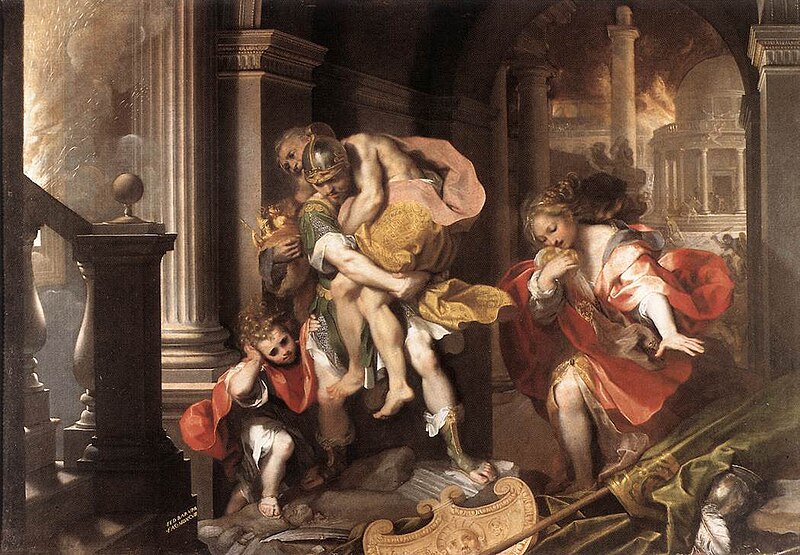
File:Aeneas' Flight from Troy by Federico Barocci.jpg

he national epic of mythical Rome, the Aeneid of Virgil, tells the story of how Trojan prince Aeneas came to Italy. The Aeneid was written under Augustus, who claimed ancestry through Julius Caesar from the hero and his mother Venus. According to the Aeneid, the survivors from the fallen city of Troy banded together under Aeneas and underwent a series of adventures around the Mediterranean Sea, including a stop at newly founded Carthage under the rule of Queen Dido, eventually reaching the Italian coast. The Trojans were thought to have landed in an area between modern Anzio and Fiumicino, southwest of Rome, probably at Laurentum or, in other versions, at Lavinium, a place named for Lavinia, the daughter of King Latinus whom Aeneas married. This started a series of armed conflicts with Turnus over the marriage of Lavinia.[3] Before the arrival of Aeneas, Turnus was engaged to Lavinia, who then married Aeneas, starting the war.[3] Aeneas won the war and killed Turnus.[3] The Trojans won the right to stay and to assimilate with the local peoples. The young son of Aeneas Ascanius, also known as Iulus, went on to found Alba Longa and the line of Alban kings who filled the chronological gap between the Trojan saga and the traditional founding of Rome in the 8th century BC.
Toward the end of this line, King Procas was the father of Numitor and Amulius. At Procas' death, Numitor became king of Alba Longa, but Amulius captured him and sent him to prison; he also forced Numitor's daughter Rhea Silvia to become a virgin priestess among the Vestals. For many years, Amulius was the king. The tortuous nature of the chronology is indicated by Rhea Silvia's ordination among the Vestals, whose order was traditionally said to have been founded by Romulus's successor Numa Pompilius.

 Sabines, Samnites and Campanians spoke in variations of the Latin's tribal language which was linked to Oscan, enabling them to communicate when they came in contact. Much the same way that the present day French, Spanish and Italian people can understand some of each other's words through their latin roots. Eventually the variations evolved into one commonly used form of latin spoken by the Umbrians

ater colonising tribes came from the Eastern area of the Mediterranean. By the end of the Bronze age the peninsula was dominated by migrating tribes from the Aegean. The influential Etruscans arrived with their highly developed artistic culture, and a language that included an obscure form of the Greek Alphabet. The Greeks settled in the southern part of 'the boot' and Sicily, building Syracuse - one of the greatest cities of the ancient world!
When the Greeks waged war against the city of Troy, the Trojan hero Aeneas sailed across the Mediterranean Sea and founded Lavinium on the Italian Peninsula

46 Parthian Empire


The Parthian Empire (/ˈpɑːrθiən/; 247 BC – 224 AD), also known as the Arsacid Empire (/ˈɑːrsəsɪd/),[6] was a major Iranianpolitical and cultural power in ancient Iran and Iraq.[7] Its latter name comes from Arsaces I of Parthia[8] who, as leader of the Parnitribe, founded it in the mid-3rd century BC when he conquered the region of Parthia[9] in Iran's northeast, then a satrapy(province) in rebellion against the Seleucid EmpireMithridates I of Parthia (r. c. 171–138 BC) greatly expanded the empire by seizing Media and Mesopotamia from the Seleucids. At its height, the Parthian Empire stretched from the northern reaches of theEuphrates, in what is now central-eastern Turkey, to eastern Iran. The empire, located on the Silk Road trade route between theRoman Empire in the Mediterranean Basin and the Han Empire of China, became a center of trade and commerce.
The Parthians largely adopted the art, architecture, religious beliefs, and royal insignia of their culturally heterogeneous empire, which encompassed PersianHellenistic, and regional cultures. For about the first half of its existence, the Arsacid court adopted elements of Greek culture, though it eventually saw a gradual revival of Iranian traditions. The Arsacid rulers were titled the "King of Kings", as a claim to be the heirs to the Achaemenid Empire; indeed, they accepted many local kings as vassals where the Achaemenids would have had centrally appointed, albeit largely autonomous, satraps. The court did appoint a small number of satraps, largely outside Iran, but these satrapies were smaller and less powerful than the Achaemenid potentates. With the expansion of Arsacid power, the seat of central government shifted from Nisa to Ctesiphon along the Tigris (south of modernBaghdad, Iraq), although several other sites also served as capitals.
The earliest enemies of the Parthians were the Seleucids in the west and the Scythians in the east. However, as Parthia expanded westward, they came into conflict with the Kingdom of Armenia, and eventually the late Roman Republic. Rome and Parthia competed with each other to establish the kings of Armenia as their subordinate clients. The Parthians soundly defeatedMarcus Licinius Crassus at the Battle of Carrhae in 53 BC, and in 40–39 BC, Parthian forces captured the whole of the Levantexcept Tyre from the Romans. However, Mark Antony led a counterattack against Parthia, although his successes were generally achieved in his absence, under the leadership of his lieutenant Ventidius. Also, various Roman emperors or their appointed generals invaded Mesopotamia in the course of the several Roman-Parthian Wars which ensued during the next few centuries. The Romans captured the cities of Seleucia and Ctesiphon on multiple occasions during these conflicts, but were never able to hold on to them.
Frequent civil wars between Parthian contenders to the throne proved more dangerous to the Empire's stability than foreign invasion, and Parthian power evaporated when Ardashir I, ruler of Estakhr in Fars, revolted against the Arsacids and killed their last ruler, Artabanus V, in 224 AD. Ardashir established the Sassanid Empire, which ruled Iran and much of the Near East until theMuslim conquests of the 7th century AD, although the Arsacid dynasty lived on through the Arsacid Dynasty of Armenia, theArsacid dynasty of Iberia, and the Arsacid Dynasty of Caucasian Albania; all eponymous branches of the Parthian Arsacids.
Native Parthian sources, written in ParthianGreek and other languages, are scarce when compared to Sassanid and even earlier Achaemenid sources. Aside from scattered cuneiform tablets, fragmentary ostraca, rock inscriptions, drachma coins, and the chance survival of some parchment documents, much of Parthian history is only known through external sources. These include mainly Greek and Roman histories, but also Chinese histories, prompted by the market for Chinese goods in Parthia.Parthian artwork is viewed by historians as a valid source for understanding aspects of society and culture that are otherwise absent in textual sources.


////////////

45 Seleucid Empire


https://en.wikipedia.org/wiki/Seleucid_Empire


File:Seleucid Empire (flat map).svg


Seleucid Empire


The Seleucid Empire (/sɪˈljsɪd/;[6] Ancient GreekΒασιλεία τῶν ΣελευκιδῶνBasileía tōn Seleukidōn) was a Hellenistic state ruled by the Seleucid dynasty, which existed from 312 BC to 63 BC; it was founded by Seleucus I Nicator following the division of the Macedonian empire vastly expanded by Alexander the Great.[7][8][9][10] Seleucus received Babylonia and, from there, expanded his dominions to include much of Alexander's near eastern territories. At the height of its power, it included centralAnatoliaPersia, the LevantMesopotamia, and what is now KuwaitAfghanistan, and parts of Pakistan and Turkmenistan.
The Seleucid Empire was a major center of Hellenistic culture that maintained the preeminence of Greek customs where a Greek political elite dominated, mostly in the urban areas.[10][11][12][13] The Greek population of the cities who formed the dominant elite were reinforced by immigration from Greece.[10][11] Seleucid expansion into Anatolia and Greece was abruptly halted afterdecisive defeats at the hands of the Roman army. Their attempts to defeat their old enemy Ptolemaic Egypt were frustrated by Roman demands. Having come into conflict with Chandragupta Maurya of the Maurya Empire, after several defeats, Seleucus entered into an agreement with Maurya where he ceded vast territory west of the Indus, including the Hindu Kush, modern day Afghanistan, and the Balochistan province of Pakistan and offered his daughter for marriage to the Emperor to formalize the alliance. Much of the eastern part of the empire was conquered by the Parthians under Mithridates I of Parthia in the mid-2nd century BC, yet the Seleucid kings continued to rule a rump state from Syria until the invasion by Armenian king Tigranes the Great and their ultimate overthrow by the Roman general Pompey.
Starting from the 2nd century BC, ancient writers referred to the Seleucid ruler as the King of SyriaLord of Asia, and other designations;[14] the evidence for the Seleucid rulers representing themselves as kings of Syria is provided by the inscription of a certain Antigonus son of Menophilus, who described himself as the "admiral of Alexander, king of Syria"

Alexander conquered the Persian Empire under its last Achaemenid dynast, Darius III, within a short time frame. He died young in 323 BC, leaving an expansive empire of partly Hellenised culture without an adult heir. The empire was put under the authority of a regent in the person of Perdiccas, and the territories were divided between Alexander's generals, who thereby became satraps, at the Partition of Babylon, all in that same year.

Rise of Seleucus[edit]

Alexander's generals (the Diadochi) jostled for supremacy over parts of his empire. Ptolemy, a former general and the satrap ofEgypt, was the first to challenge the new system; this led to the demise of Perdiccas. Ptolemy's revolt led to a new subdivision of the empire with the Partition of Triparadisus in 320 BC. Seleucus, who had been "Commander-in-Chief of the Companion cavalry" (hetairoi) and appointed first or court chiliarch (which made him the senior officer in the Royal Army after the regent and commander-in-chief Perdiccas since 323 BC, though he helped to assassinate him later) received Babylonia and, from that point, continued to expand his dominions ruthlessly. Seleucus established himself in Babylon in 312 BC, the year used as the foundation date of the Seleucid Empire. He ruled not only Babylonia, but the entire enormous eastern part of Alexander's empire, as described by Appian:
Always lying in wait for the neighboring nations, strong in arms and persuasive in council, he [Seleucus] acquired Mesopotamia, Armenia, 'Seleucid' Cappadocia, Persis, Parthia, Bactria, Arabia, Tapouria, Sogdia, Arachosia, Hyrcania, and other adjacent peoples that had been subdued by Alexander, as far as the river Indus, so that the boundaries of his empire were the most extensive in Asia after that of Alexander. The whole region from Phrygia to the Indus was subject to Seleucus.[16]
Seleucus went as far as India, where, after two years of war, he reached an agreement with Chandragupta Maurya, in which he exchanged his eastern territories for a considerable force of 500 war elephants, which would play a decisive role at Ipsus (301 BC).Strabo, in his Geographica, wrote:
The Indians occupy [in part] some of the countries situated along the Indus, which formerly belonged to the Persians: Alexander deprived the Ariani of them, and established there settlements of his own. But Seleucus Nicator gave them toSandrocottus (Chandragupta Maurya) in consequence of a marriage contract, and received in return five hundred elephants
Following his and Lysimachus' victory over Antigonus Monophthalmus at the decisive Battle of Ipsus in 301 BC, Seleucus took control over eastern Anatolia and northern Syria.
In the latter area, he founded a new capital at Antioch on the Orontes, a city he named after his father. An alternative capital was established at Seleucia on the Tigris, north of Babylon. Seleucus's empire reached its greatest extent following his defeat of his erstwhile ally, Lysimachus, at Corupedion in 281 BC, after which Seleucus expanded his control to encompass western Anatolia. He hoped further to take control of Lysimachus's lands in Europe – primarily Thrace and even Macedonia itself, but was assassinated by Ptolemy Ceraunuson landing in Europe.
His son and successor, Antiochus I Soter, was left with an enormous realm consisting of nearly all of the Asian portions of the Empire, but faced with Antigonus II Gonatas in Macedonia and Ptolemy II Philadelphus in Egypt, he proved unable to pick up where his father had left off in conquering the European portions of Alexander's empire
Nevertheless, even before Seleucus' death, it was difficult to assert control over the vast eastern domains of the Seleucids. Seleucus invaded the Punjab region of India in 305 BC, confronting Chandragupta Maurya (Sandrokottos), founder of the Maurya Empire. It is said that Chandragupta fielded an army of 600,000 men and 9,000 war elephants.[18]
Mainstream scholarship asserts that Chandragupta received vast territory, sealed in a treaty, west of the Indus, including the Hindu Kush, modern day Afghanistan, and theBalochistan province of Pakistan.[19][20] Archaeologically, concrete indications of Mauryan rule, such as the inscriptions of the Edicts of Ashoka, are known as far as Kandahar in southern Afghanistan. According to Appian:
He [Seleucus] crossed the Indus and waged war with Sandrocottus [Maurya], king of the Indians, who dwelt on the banks of that stream, until they came to an understanding with each other and contracted a marriage relationship."[21]
It is generally thought that Chandragupta married Seleucus's daughter, or a Macedonian princess, a gift from Seleucus to formalize an alliance. In a return gesture, Chandragupta sent 500 war-elephants,[22][23][24][25][26] a military asset which would play a decisive role at the Battle of Ipsus in 301 BC. In addition to this treaty, Seleucus dispatched an ambassador, Megasthenes, to Chandragupta, and later Deimakos to his son Bindusara, at the Mauryan court at Pataliputra (modern Patna in Bihar state). Megasthenes wrote detailed descriptions of India and Chandragupta's reign, which have been partly preserved to us through Diodorus Siculus. Later Ptolemy II Philadelphus, the ruler of Ptolemaic Egypt and contemporary of Ashoka the Great, is also recorded by Pliny the Elder as having sent an ambassador named Dionysius to the Mauryan court.[27]
Other territories lost before Seleucus' death were Gedrosia in the south-east of the Iranian plateau, and, to the north of this, Arachosia on the west bank of the Indus River.
Antiochus I (reigned 281–261 BC) and his son and successor Antiochus II Theos (reigned 261–246 BC) were faced with challenges in the west, including repeated wars withPtolemy II and a Celtic invasion of Asia Minor—distracting attention from holding the eastern portions of the Empire together. Towards the end of Antiochus II's reign, various provinces simultaneously asserted their independence, such as Bactria and Sogdiana under DiodotusCappadocia under Ariarathes III, and Parthia under Andragoras. A few years later, the latter was defeated and killed by the invading Parni of Arsaces - the region would then become the core of the Parthian Empire

44 alexander the great


Alexander's Empire


Alexander III the Great, the King of Macedonia and conqueror of the Persian Empire is considered one of the greatest military geniuses of all times. He was inspiration for later conquerors such as Hannibal the Carthaginian, the Romans Pompey and Caesar, and Napoleon.  Alexander was born in 356 BC in Pella, the ancient capital of Macedonia. He was son of Philip II, King of Macedonia, and Olympias, the princess of neighboring Epirus.
Alexander spent his childhood watching his father transforming Macedonia into a great military power, winning victory after victory on the battlefields throughout the Balkans.   At age 12 he showed his equestrian skill to his father and all who were watching when he tamed Bucephalus, an unruly stallion horse, unable to be ridden and devouring the flesh of all who had tried. Plutarch writes:
"Philip and his friends looked on at first in silence and anxiety for the result, till seeing him turn at the end of his career, and come back rejoicing and triumphing for what he had performed, they all burst out into acclamations of applause; and his father shedding tears, it is said, for joy, kissed him as he came down from his horse, and in his transport said, 'O my son, look thee out a kingdom equal to and worthy of thyself, for Macedonia is too little for thee' "(Alex. 6.8.).
Alexander would ride Bucephalus in all of his major battles, together till the very end. When he was 13, Philip hired the Greek philosopher Aristotle to be Alexander’s personal tutor.  During the next three years Aristotle gave Alexander a training in rhetoric and literature and stimulated his interest in science, medicine, and philosophy, all of which became of importance in Alexander’s later life. 
In 340, when Philip assembled a large Macedonian army and invaded Thrace, he left his 16 years old son with the power to rule Macedonia in his absence as regent, which shows that even at such young age Alexander was recognized as quite capable.  But as the Macedonian army advanced deep into Thrace, the Thracian tribe of Maedi bordering north-eastern Macedonia rebelled and posed a danger to the country.  Alexander assembled an army, led it against the rebels, and with swift action defeated the Maedi, captured their stronghold, and renamed it after himself to Alexandropolis.  Two years later in 338 BC, Philip gave his son a commanding post among the senior generals as the Macedonian army invaded Greece. At the Battle of Chaeronea the Greeks were defeated and Alexander displayed his bravery by destroying the elite Greek force, the Theban Secret Band. Some ancient historians recorded that the Macedonians won the battle thanks to his bravery.
Family Split and the Assassination of Philip II
But not too long after the defeat of the Greeks at Chaeronea, the royal family split apart when Philip married Cleopatra, a Macedonian girl of high nobility. At the wedding banquet, Cleopatra's uncle, general Attalus, made a remark about Philip fathering a ‘legitimate’ heir, i.e., one that was of pure Macedonian blood. Alexander threw his cup at the man, blasting him for calling him 'bastard child’. Philip stood up, drew his sword, and charged at Alexander, only to trip and fall on his face in his drunken stupor at which Alexander shouted:  
"Here is the man who was making ready to cross from Europe to Asia, and who cannot even cross from one table to another without losing his balance."
He then took his mother and fled the country to Epirus. Although allowed to return later, Alexander remained isolated and insecure at the Macedonian court.


///////////////////////////

43 persia

http://www.ushistory.org/civ/4e.asp


Bedouin


In 539 B.C.E., King Cyrus decided to expand the boundaries of Persia. He began by conquering Babylon. Unlike Assyrian kings, Cyrus was known for his mercy rather than his cruelty.

For example, he allowed the Hebrews, who had been captives in Babylon for over fifty years to return to the holy city of Jerusalem, instead of turning them into slaves. He returned sacred items that were stolen from them and allowed the rebuilding of their capital and the temple.


Cyrus also allowed the Hebrews to continue living and worshiping as they chose. The Jewish prophet, Isaiah, called Cyrus "God's shepherd," and said that "God would go before him and level the mountains."


Cyrus's generosity toward the Jews was not an isolated event. He and his successors employed a policy of adaptation and reconciliation toward all of their new subjects. They cooperated with local rulers and interfered as little as possible in matters that did not directly relate to their rule. They respected local traditions and even adopted some of their subjects' religious practices for themselves.

Rather than destroy local economies for their own selfish gain, the Persians worked to increase trade throughout their kingdom. They standardized weights, developed official coinage, and implemented universal laws.

The Persian leaders required cooperation and imposed a 20 percent tax on all agriculture and manufacturing. They also taxed religious institutions, which despite their wealth had previously not been taxed.

The Persians themselves paid no taxes.

The Persian kings — especially Cyrus and, later, Darius I (522-486 B.C.E.) — developed a model for the administration of a large empire that was copied by others in the future. Laws were carried out fairly and evenly among all of the various subject peoples.


The Persians divided their empire into 20 provinces that were managed by governors. In addition, they provided land to feudal lords in exchange for loyalty and guarantees of soldiers for the Persian army. Most of the people in the empire, including average 

Persians, simply remained struggling farmers or
 craftspeople.


Cyrus built the foundations of a courier, or mail, system. Darius I built a communication network that connected most of the empire. A 1,600-mile-long royal road was built from Sardis to Susa, one of the administrative capitals. Along this road, were numerous places for lodging, where royal couriers could obtain fresh horses and supplies.

The Persians also developed a religion based on monotheism, the belief in one god. It was founded by the prophet Zoroaster, called Zarathustra in old Iranian. Many of his ideas were collected in a series of poems called the Gathas,which became part of the religion's most sacred book, the Avesta


Zoroaster believed that people were training for a future life. He taught that the earthly world was torn by a constant struggle between good and evil. Humans would have to choose between the two in preparation for a final judgment when good would triumph over evil. When this happened, all earthly existence would disappear. The Zoroastrian god, Ahura Mazda, embodied goodness and wisdom. Some religious scholars believe that Zoroaster's ideas strongly influenced on the development of the Hebrew and Christian religions.
Despite the Persians' effective and conciliatory leadership, their empire did not last. Under King Xerxes in 480 B.C.E., the Persians made an attempt to expand their empire into Greece. The Greek city-states cooperated and held off the Persian threat and even succeeded in almost obliterating the Persian navy.


42 Persian people


Persian people


The Persian people[27] (Persian: پارسیان) are an Iranian people who speak the modern Persian language[28] and closely related Iranian dialects and languages.[29][30]
The term Persian translates to "from Persis" which is a region north of the Persian Gulf located in Pars, Iran. It was from this region that Cyrus the Great, the founder of the Achaemenid empire, united all other Iranian empires (such as the Medes), and expanded the Persian cultural and social influences by incorporating the Babylonian empire, and the Lydian empire. Although not the first Iranian empire, the Achaemenid empire is the first Persian empire well recognized by Greek and Persian historians for its massive cultural, military and social influences going as far as Athens, Macedonia, Egypt, and Libya

Persians have generally been a pan-national group often comprising regional people who often refer to themselves as "Persians" and have also often used the term "Iranian" (in the ethnic-cultural sense)[citation needed]. Some scholars, mechanically identifying the speakers of Persian as a distinct ethnic unit (the ‘Persians’), exclude those Iranians who speak dialects of Persian. However, this approach can be misleading, as historically all ethnic groups in Iran were collectively referred to as Iranians or Persians until 1935, when Rezā Shāh formally required foreign countries to call Persia by its native name, Iran.